
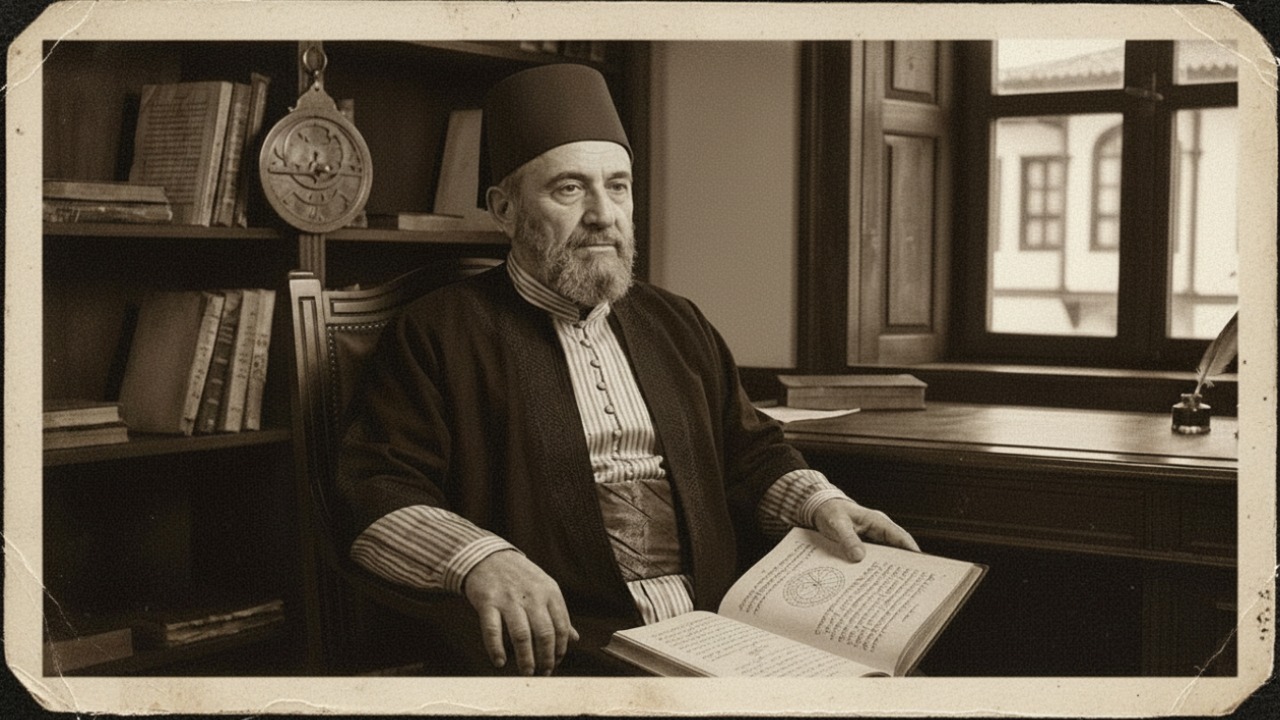
A FAMOUS 19th CENTURY OTTOMAN ASTROLOGER: SADULLAH AL-ANKARAWİ
Astrology, which was called ilm-i Ahkâm-i nujum, was a part of daily life in Ottoman culture which was divided into two parts as natural astrology and Ahkâm (predictive astrology). Ahkâm, which means “predictive astrology”, was divided into three branches as Mevalid (na-tal astrology), Mesail (horary astrology) and Ihtiyarat (electional astrology). These three branches were also used for making a close circle and maintaining good human relations, while some munajjims were famous and made a name on these branches. One of these munajjims was Sadullah Efendi of Ankara (Muderriszade Sadullah Al-Ankarawi) who lived in the first half of the 19th century. As he was a senior bureaucrat and had knowledge on various subjects, he was in contact with top government officials in Ottoman Empire. He erected their natal charts and also horary charts. In addition to these charts, as he gave some information about the important persons and the events of that era, he attracted attention as a wise and enlightened Sufi. Some samples of charts and calendars are found in Kandilli Observatory Library.
Among many other books written by several astrologers in that library, Sadullah Efendi’s Mecmuatu’l Ahkâm was spectacular due to its size and content. While we have been carrying a project, TAMAK – the abbreviation for The Project for Researches and Reintroduction of Ancient Astrological Texts, which started as of April 9 2015, we came across with this book which may be called as “The Book of All Judgements”. Tahsin Tahaoglu, the library manager, told us it was hard to find such an enormous book and so we decided to get a copy of this unique book. This work of Sadullah Efendi is very important as it tells how astrology was studied and practiced in the Ottoman Empire and the mental world of the day. Sadullah Efendi made a great job through transmitting us information given by his predecessors and shedding light to astrological methods used in Ottoman era.
Who is Sadullah Al-Ankarawi?
Muderriszade (Scholar) Sadullah Al-Ankarawi, whose full name is Muderriszade Seyyid Sadullah b. Aldulkerim b. Mustafa Sheyhi al-Ankarawi and who lived in the first half of the 19th century, was a scholar who descended from Haci Bayram Veli and worked as a mufti, regent, and minister of registry. He inherited his facility with ilm-i nujum from his ancestors. His grandfather, Mustafa Efendi was talented in poetry, science and astrology and his father Abdulkerim Efendi was also an expert on ilm-i nujum. He was also famous with his poetry.
Muderriszade Sadullah Al-Ankarawi is one of the famous students trained by Head-Munajjim Rakim Efendi who was a wellknown scientist in the Ottoman giving lessons at Mekteb-i Fenn-i Nujum which was the first astronomy school in Istanbul. He studied the methods for preparing astrological calendars, two of which he specifically recorded as having been prepared under the supervision of Rakim Efendi. The calendar he prepared and the notes he took on them contained very important information. He also prepared calendars and horoscopes for some high rank statesman as well as for his various clients and was paid for them. He had a strong client network in Ankara and Istanbul. With the horoscopes he prepared for the inquiries of his clients and high rank persons, he also prepared many horoscopes for ordinary people and his own questions to locate lost objects; such as his stolen pipe, his servants etc. He elected an auspicious time for his own wedding as well. He was married twice. He taught astrology to his son Mustafa Pertev Efendi. He recorded all manner of natural and human events: these included births, deaths, appointments, dismissals, the activities of his entourage, his own financial commitments, personal concerns, and the inquiries addressed to him. As researcher Gülçin Tunali Koç addresses in her unpublished thesis, Sadullah Efendi mentioned his servants in his horoscope collection and calendars, and between 1826 and 1849 he had thirty-four of them.
Sadullah Al-Ankarawi also attracted the attention of Miri Shefer Mossensohn, who is one of the professors in Tel Aviv University and made researches on science in Ottoman era and had a book on Ottoman Medicine translated into Turkish, and took place in his latest book “Science Among the Ottomans: The Cultural Creation and Ex¬change of Knowledge”. In the book that describes the last periods of the Ottoman Empire, it is told that Sadullah Al-Ankarawi used his scientific expertise to position himself within Ottoman political culture in the chapter on astrology activities in the Ottoman.
TAMAK: The Project for Researches and Reintroduction of Ancient Astrological Texts
On April 9, 2015, we have started The Project for Researches and Reintroduction of Ancient Astrological Texts in our school. The purpose of this project is to investigate the development process of astrology after the spread of Islam, to identify the books written in Arabic and Ottoman Turkish during this period, to translate these books into today’s Turkish and publish, to organize seminars, workshops and trainings on this topic and to inform the astrology researchers, students and the public on this topic.
After long researches, we decided to study on Sadullah Efendi’s Mecmuatu’l Ahkâm which we had access to it through Associate Professor Nalan Turna who made us aware of this book as our School’s precious graduate. I would like to thank dear Gülçin Tunalı Koç who helped us discover Sadullah Efendi’s Mecmuatu’l Ahkâm and consequently, encouraged us to prepare such a book. Her article on ilm-i nujum as a reference to understand political culture in the Ottoman and her thesis titled “Daily Concerns of an Ottoman Astrologer” played a significant role for us to understand Sadullah Efendi’s contributions for this field.
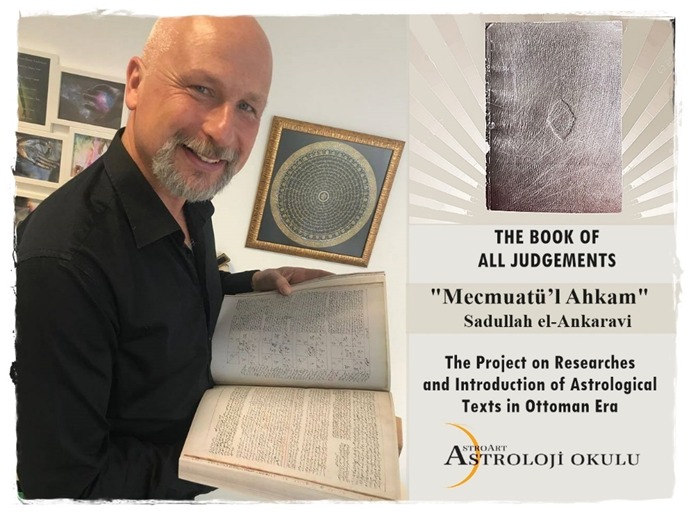
Since the book was a manuscript, our first priority was to rewrite the text in Latin letters.
It took us nearly one year to do that. It was hard to find someone who could read the manuscript, and to convince him to rewrite these 578 pages and to find another one after this person quitted was a long and tiring process which we met with dozens of people, my friend Şükran Bakacak’s efforts were truly admirable. Şükran Öztürk, a student of mine, started translating from Ottoman Turkish and Arabic as soon as some pages have been written in Latin letters. The book was written by an intellectual person in three different languages, including Persian, and was a tremendous treasury.
Sadullah Efendi did not only have mastery in astrology, but he also had a good knowledge of the language. His grammar was good enough to use Ottoman, Arabic and Persian with all their richness. Although we had voluminous dictionaries, could not find some of the words he used. As he was also a poet, his literary style was apparent even in his astrological texts.
We sometimes spent long hours for finding the meaning of some of the words he used and sometimes had difficulties because of his messy style, so translating the text took a long time than we expected. However, at last we could prepare the necessary infrastructure for the first volume of the set which is composed of five volumes:
1. Tehavil (Solar return), Ricat (retrograde) and planetary aspects
2. Mundane astrology
3. Ihtiyarat (Electional astrology)
4. Mevalid (Natal astrology)
5. Mesail (Horary astrology)
Mecmuatu’l Ahkâm: The Book of All Judgements
Sadullah Efendi’s Mecmuatu’l Ahkâm was written in three different languages including Ottoman Turkish, Arabic and Persian because the author made some quotations from his antecedents in this book and preserved the original language of these quotations. The reference books which were highly accepted were compiled and a single book called Ahkâm was created. (Ahkâm: A compilation of the rules and judgements) Sadullah Efendi compiled the works of his predecessors, sometimes added his own opinions and sometimes quoted from them even if he does not agree with the comments. As his father and grandfather were also astrologers, he was used to this terminology and knowledge from his childhood. He also added some comments to this book that he heard from his grandfather. In Mecmuatu’l Ahkâm square charts were used as it was in the classical era. You may see a sample chart drawing below.
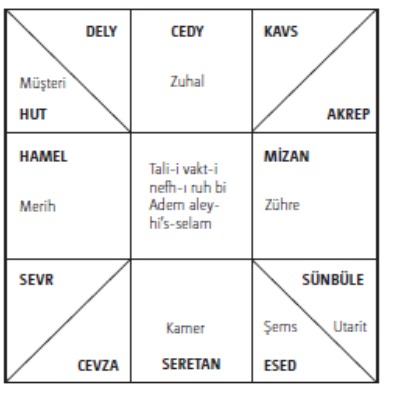
A Square Chart Sample
In some sample charts given by Sadullah Efendi, especially in Aries Ingress charts, we see that there is some information about the important events of that year. Some of these charts are quoted from the author’s grandfather’s studies as indicated with the phrases like “from my grandfather’s texts” or “from Asar-ı Zekiyye”. Below, you may see two samples. We will prepare another book on Ottoman Astrology focusing on Mundane Astrology and give other samples.
I am sure Sadullah Efendi was an avid reader who read various books on astrology because in his Mecmuatu’I Ahkâm there is some information on planetary aspects from Abu Ma’shar’s Introduction to Traditional Astrology, Abu’l Kasim’s (Alcabitus) book, Abraham Ibn Ezra’s The Beginning of Wisdom and Guido Bonatti’s Liber Astronomiae. Then all these theories were practiced with William Lilly’s Christian Astrology and Sadullah Efendi was highly influenced by William Lilly.
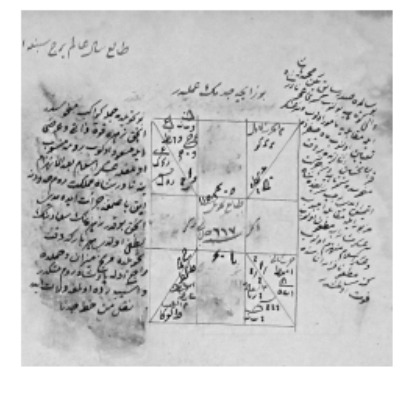
Quoted from Mecmuat: “This horoscope is prepared by my grandfather.”
In the middle: Ingress chart for the year 1158. (Year 667, based on Jalali calendar.)
Right hand side: Former Grand-vizier Mehmed Pasha who was the governor of Kutahya was commanded to battle with Nadir Shah, who was the Persian King. He was appointed as the commander in Safar (the 2nd month of the Islamic calendar) and mobilized against the Persian King in an unfortunate time when the two malefics were in conjunction. The above mentioned commander caught plague and the Islamic army was defeated. He died when he was running away as a sick man.
Left hand side: All the planets in this Ingress chart are unfortunate however as Venus had both essential and accidental dignity, although Nadir Shah won the battle, he could not dare step in the country. This was the only favor of Venus. Whenever Mars retrogrades in Aries or Libra, it indicates trouble and sorrow for the Sultan of the Rum as quoted from my grandfather’s texts.
Ingress Chart for Istanbul, the 2nd day of Ramadan (the 9th month of the Islamic calendar) 1142 from Asar-i Zekiyye.
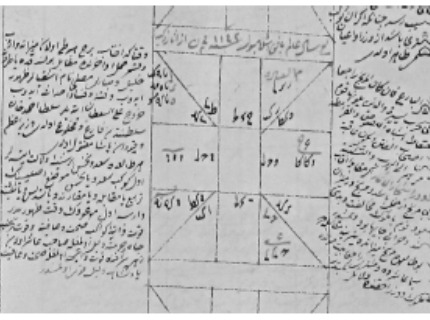
Right hand side: As quoted by Bari, “If Mars is retrograde, war breaks out in societies like Karamita where there is theft and unrest, and sorrow and suffering follows.” In this chart, Mars in Libra is in opposition to the Luminaries in the 10th house, and Jupiter is retrograde in the house of death indicating misfortune for the kings and the viziers.
Left hand side: When the Sun entered Libra where it is in fall and made an opposition with the Moon at the last degrees of Aries, some bandits like Patrona Halil and Sari Musullu and rebelled against the Sultan. Sultan Ahmed Han was dethroned, the grand-vizier and the chief admiral were killed. Whether a planet indicates fortune or misfortune, when this planet makes an aspect through a square, trine, opposition, sextile or conjunction, the promises of this planet are manifested. As the essential dignity of a planet indicates being physically and spiritually healthy, and its accidental dignity indicates having power and status and being respected; Venus, the ruler of the 10th house, in its domicile (an essential dignity) indicates the health and welfare of the Sultan.
The strength of the planets
Sadullah Efendi’s Mecmuatu’l Ahkâm is a highly important book as it is handwritten and a single copy. Although printing was widespread in that era, Sadullah Efendi could not publish his book due to some bureaucratic reasons. Finally, it is time for that book to become evident! We decided to prepare book series extracted from Mecmuat in different main topics such as electional, horary, natal and mundane astrology.
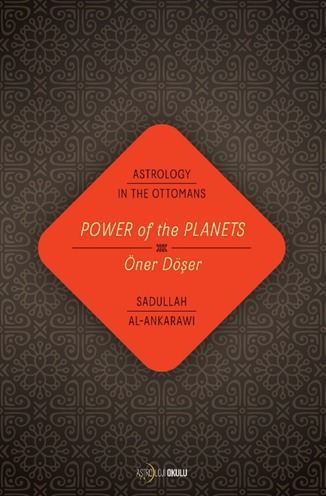
In order to understand the other books of this serial, first of all the readers need to learn the strengths and weaknesses of the planets, their positions in houses and the aspectual connections between them. So, we have first published a book titled “The Strengths of the Planets” by AstroArt Astrology School Publishing and also translated it into English which will be available soon. I hope this book will help the readers add some ancient wisdom to their astrology knowledge and obtain a new perspective.
*It was published in 2020 in OPA’s magazine The Career Astrologer.
Öner Döşer, AMA, ISAR Cap, Cert. OPA
OPA Turkey Satellite, Member of APAI
Founder of AstroArt School of Astrology